

Chicago's Lookingglass Theatre Project by John Caretti & Co. Wins National Terrazzo Award
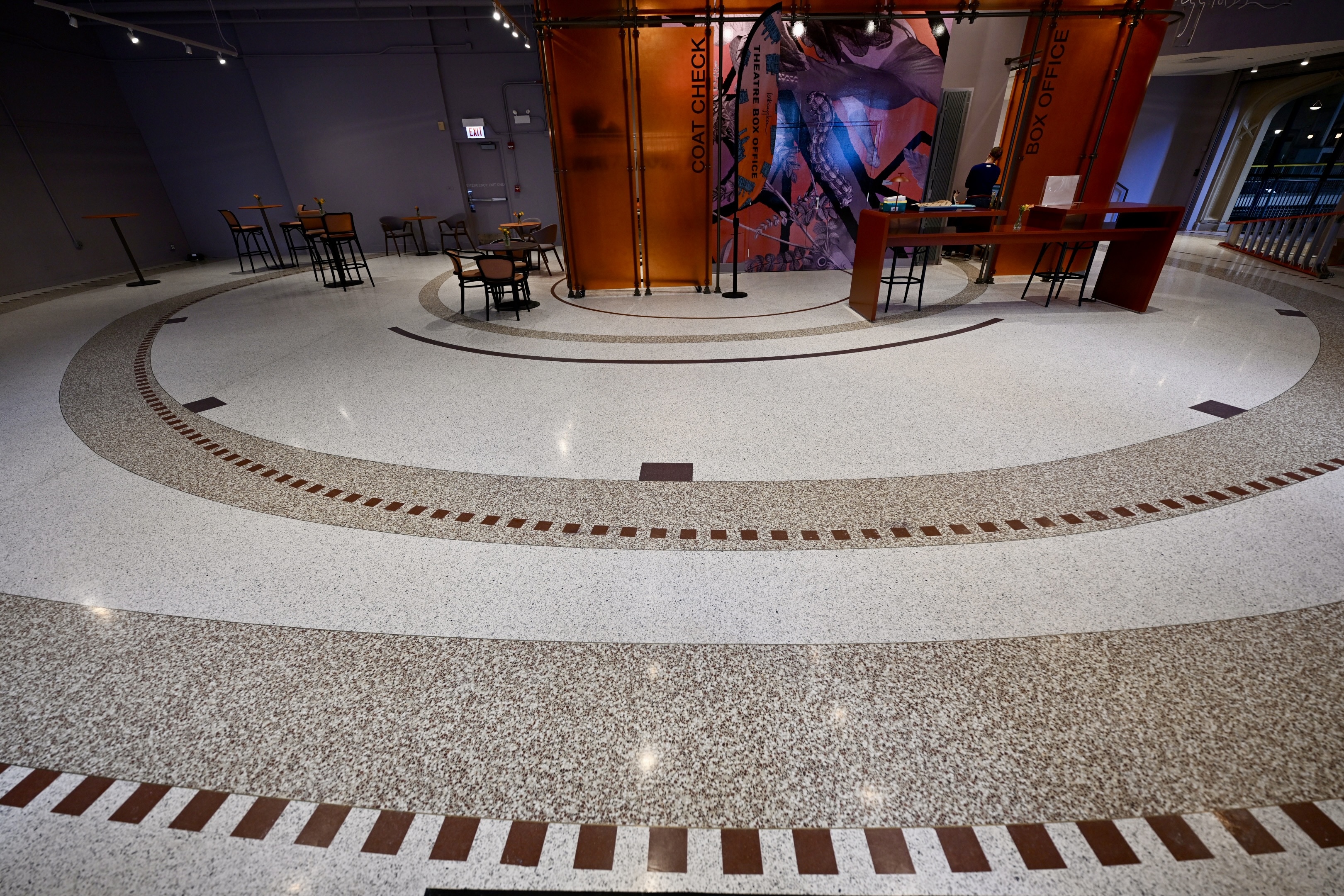
Lookingglass Theatre's award-winning terrazzo floor in a lobby expansion brought visual coherence and wayfinding in a Chicago landmark. John Caretti & Co. was the terrazzo contractor on the installation. © Jack Helmer
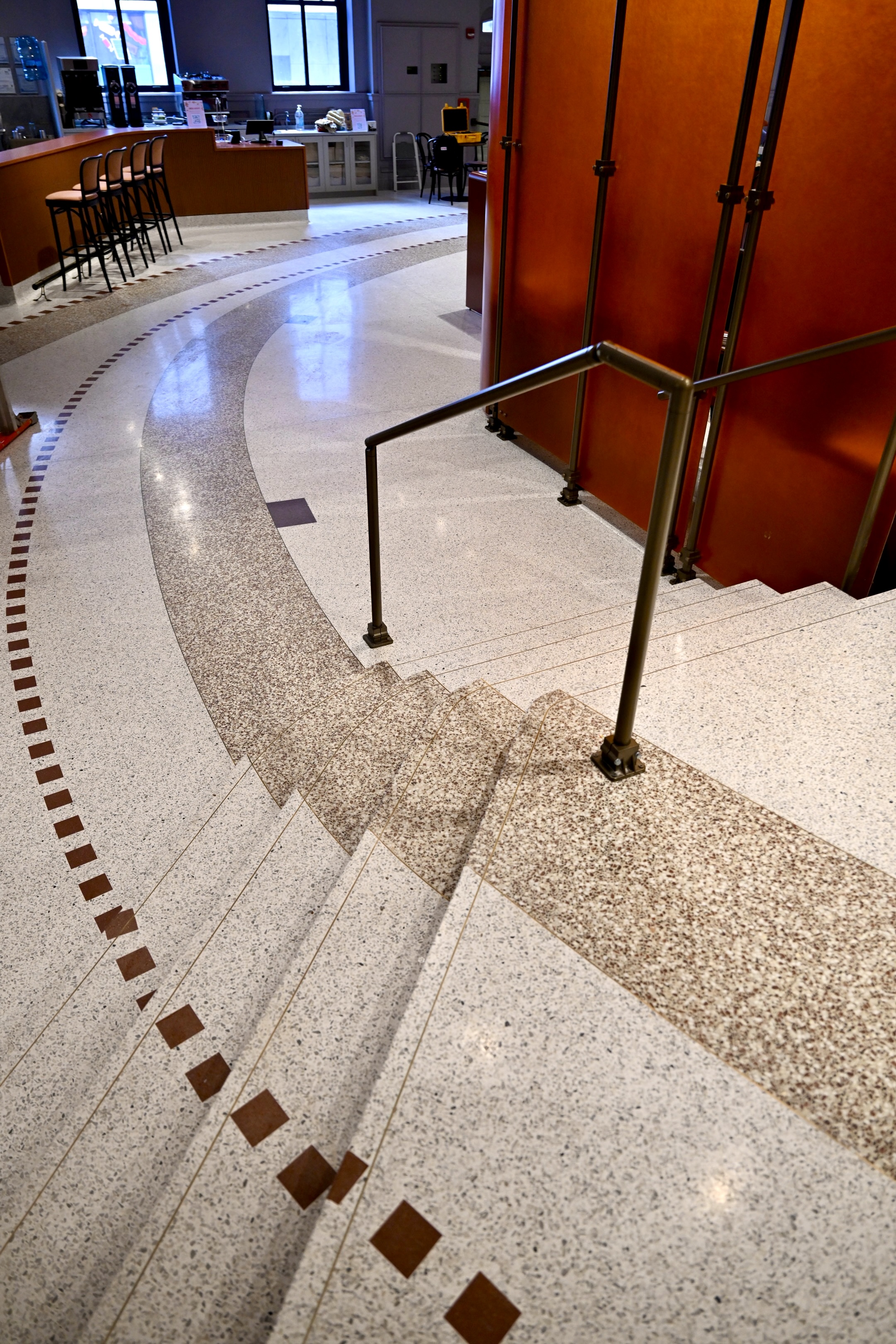
Precast terrazzo squares cascade down the stair, carrying the lobby’s floor pattern seamlessly across each step. The project was named an Honor Award winner this year for John Caretti & Co.
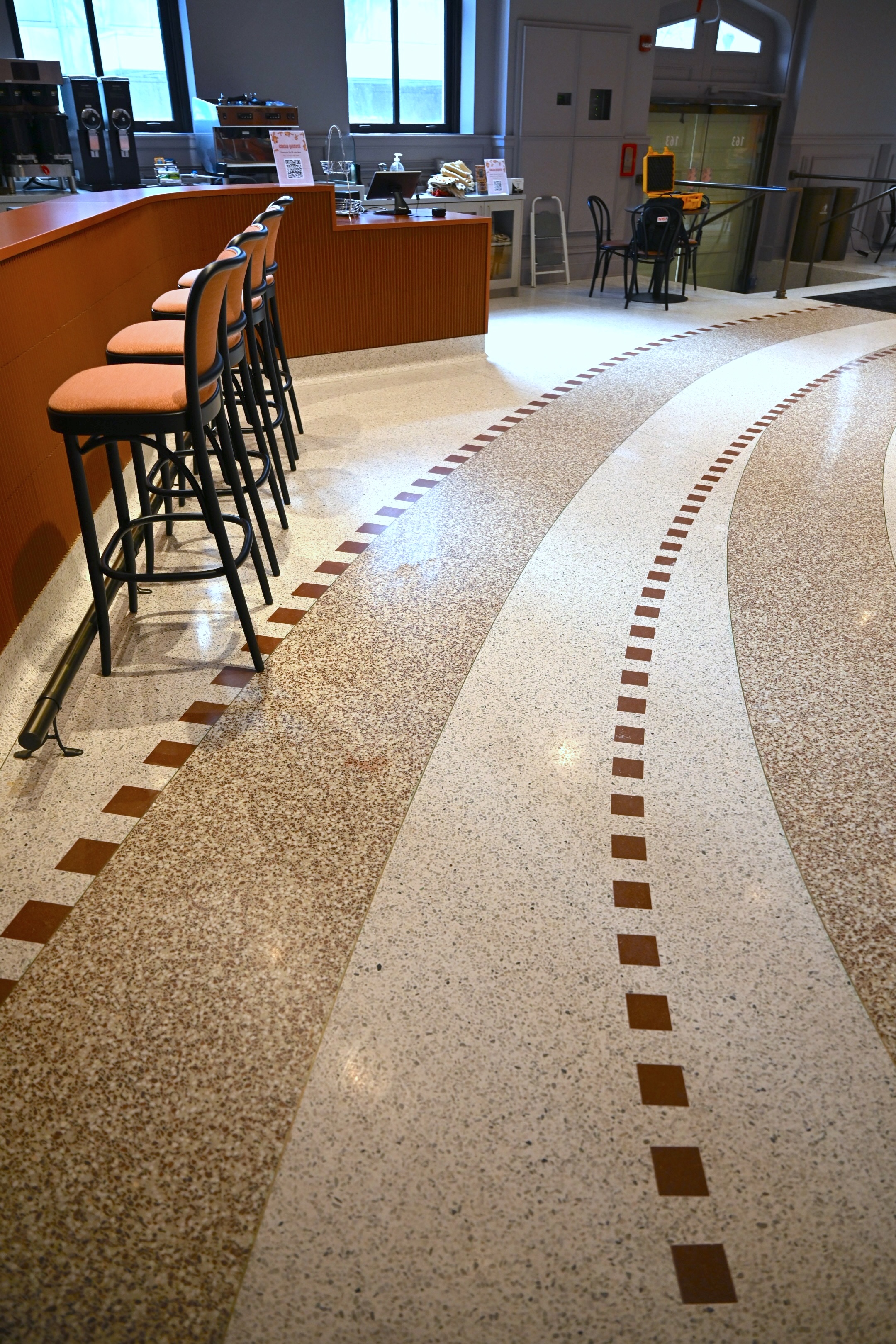
Terrazzo was poured in place in the theatre lobby, with over 600 prefabricated inserts placed by hand. The project netted a 2026 Honor Award from the National Terrazzo & Mosaic Association for John Caretti & Co. of Chicago.
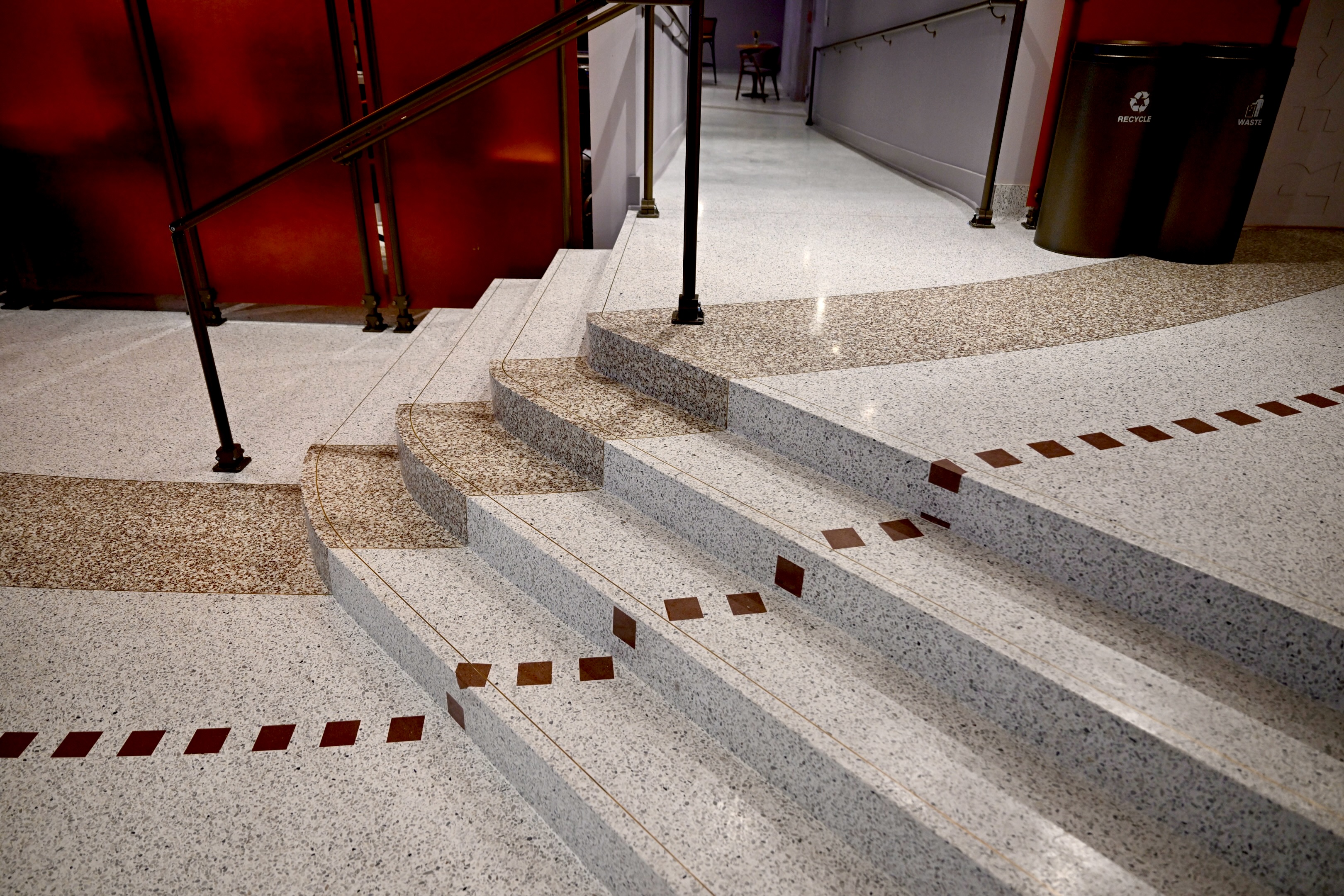
Transitions in levels and surfaces were unified in the new lobby space, wrapping stair edges.

Wheeler Kearns Architects needed one floor to span multiple levels and surfaces in a historic space. Terrazzo delivered permanence, wayfinding, and provenance.
The Space and the Problem
Lookingglass Theatre occupies the Chicago Avenue Pumping Station, a Gothic Revival landmark built in 1869 and one of the few Chicago structures that predate the Great Chicago Fire. When Wheeler Kearns Architects took on the lobby expansion, the space they were connecting to the existing inner lobby had neither architectural identity nor a history of institutional ownership. Calli Verkamp, Principal at Wheeler Kearns Architects, describes it as "a forgotten space."
The area to be renovated also sat two feet below the existing lobby floor. Due to the building's age, adding floor height was not an option. Whatever flooring solution the team proposed had to negotiate the level change across the stairs and ramp, unify two previously disconnected environments, and do so in a way that gave the theatre a permanent, legible claim on the intervention—all within a limited, grant-funded budget.
Caretti's first contribution came before a single strip was bent. "The architect wanted a floor finish to last for years without constant replacement," explained Sergio Calleros, Caretti’s foreman on the project. “Knowing it could also accomplish exactly what they needed it to do in this space, we suggested terrazzo. In a historic building, selecting terrazzo is a better fit to withstand heavy foot traffic." Working within the budget constraints, Caretti helped Wheeler Kearns develop a design that achieved their objectives.
"From the outset, in the concept phase, we saw terrazzo as the solution for all of those challenges," Ms. Verkamp stated. "It also gave the space permanence, and a provenance it hadn't had before."
The Design and the Solution
The floor pattern draws on ancient celestial maps. Overlapping orbits rotate around the hub of the space, with main arcs sweeping from multiple points of entry toward the inner lobby. The composition serves as wayfinding without signage; visitors follow the arcs intuitively from the entry to the inner lobby along paths that the floor makes self-evident.
"It is laid out to be an integral, subtle wayfinding," Ms. Verkamp said. The floor is four epoxy terrazzo colors, balanced by a neutral field. The marble aggregate mix creates depth and cohesion across the space.
Brass divider strips define the orbital arcs, each following a different radius. Each strip was bent by hand on site using a custom-manufactured bender. Mr. Calleros noted that the tool has since become standard on all their installations involving curves and has revolutionized their approach to the bending and shaping of divider strips.
The Installation
Ms. Verkamp noted that she had specified terrazzo for institutional projects, a single-family residence, and a museum installation, where the material wrapped vertical surfaces and cove bases in a single, seamless form. This project extended that experience to the specifics of precast fabrication and the tolerances required for a complex, multi-surface installation in a historic structure.
At Caretti's recommendation, the installation combined precast and poured-in-place terrazzo. Over 600 square terrazzo insets were fabricated independently, placed by hand within the poured-in-place field, and then the surfaces were ground and polished together to a single unified finish. The precast squares allowed the pattern to wrap stair edges and cross transitions seamlessly.
What It Accomplished
For Ms. Verkamp, the material solved problems that no other finish could have addressed as completely. A single continuous terrazzo surface runs uninterrupted from the lower entry, across the ramp and stairs, and into the inner lobby: one floor, from low to high. The entire installation was completed in 30 days.
"Integral design in the floor gives Lookingglass Theatre built-in ownership over the intervention," Ms. Verkamp recounted. She identifies the moment of entry as the aspect of the design she is most proud of. "The visual impact upon entering, the initial impression, and multiple layers to discover. The way it resolved visually is really nice, making a wonderful first impression on visitors."
Mr. Calleros describes the terrazzo floor in the Lookingglass Theatre renovation lobby as a strategic architectural gesture: one that conveys direction, anchors the space in craft and performance, ties into the theatre’s identity, and meets the practical demands of a public lobby. “It is integral to how the renovated space functions, feels, and communicates. Terrazzo suits this space perfectly, and it’s ready to stand for another 100 years,” he said.
John Caretti & Co., established in 1884, is a charter member of the NTMA.
About the National Terrazzo & Mosaic Association
The annual NTMA Honor Award program recognizes outstanding terrazzo installations completed by association member contractors. Entries are evaluated by design professionals and terrazzo specialists based on design achievement, craftsmanship, and technical execution. A full list of this year's 17 Honor Award recipients is available at ntma.com.
Founded in 1923, the NTMA is a nonprofit trade association of over 150 contractor and supplier members, headquartered in Fredericksburg, Texas. The organization establishes national standards for all terrazzo systems and applications, advancing quality craftsmanship and innovation while supporting its members in the trade.
The NTMA provides a broad range of free resources for architects, designers, artists, contractors, maintenance professionals, and property owners. From assisting design teams with specifications to offering technical guidance throughout a project, the NTMA helps ensure terrazzo installations meet the highest standards. The association also offers AIA-registered continuing education programs for architects and design professionals. For more information about terrazzo resources, visit ntma.com. NTMA Technical Director Gary French is available at gary@ntma.com.
Terrazzo originated in 15th-century Italy, building on the mosaic traditions of ancient Rome. Venetian marble workers repurposed discarded stone chips into durable, decorative surfaces—a practice that made terrazzo an early sustainable material. Today, terrazzo is still poured by hand on-site, with options for precast panels and waterjet-cut details. Stone, recycled glass, or other aggregates—which may be locally sourced—are set in a cement or epoxy base, and the surface is then polished to reveal the aggregate's color and texture. Valued for its design versatility, ease of maintenance, durability, sustainability, and lifecycle value, terrazzo is built to last the life of a building.
Chad Rakow
National Terrazzo & Mosaic Association
+1 800-323-9736
info@ntma.com
Visit us on social media:
LinkedIn
Instagram
Facebook
YouTube
TikTok
National Terrazzo & Mosaic Association 2026 Honor Awards
Legal Disclaimer:
EIN Presswire provides this news content "as is" without warranty of any kind. We do not accept any responsibility or liability for the accuracy, content, images, videos, licenses, completeness, legality, or reliability of the information contained in this article. If you have any complaints or copyright issues related to this article, kindly contact the author above.
